
“This book opens out. It expels. Its ragged blooms sing.“
–Diane Seuss, author of frank: sonnets and Modern Poetry;
winner of the Pulitzer Prize
Coming in February 2027
from Carnegie Mellon University Press
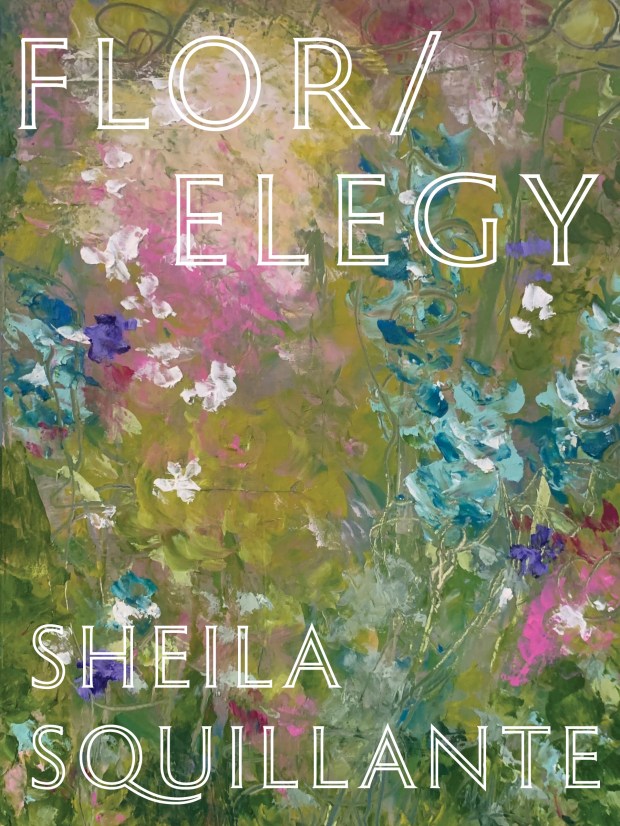
A collection of poetry that confronts grief both personal and global as the speaker faces middle age.
Flor/elegy confronts midlife grief and responsibility in a world shaped by loss, violence, and environmental precarity. Written after the death of both parents, the collection explores motherhood and long marriage, as well as our relationship to self, memory, and the natural world. Tender and unsparing, these poems ask us to pay attention, to love fiercely, to hold fast, and to endure.
Early praise for Flor/elegy
The source of metaphor in Sheila Squillante’s Flor/elegy is the garden of the real, situated in midlife, midway between celebration and the unendurable, teetering between florescence and the bottom line, offering up reliquaries of flowers and bones, within a “dazed and anxious radiance.” The grief and mischief of these poems is housed in the bodies of forms—litanies, meditations, crown-like sequences, and prose poems whose sturdiness fortifies the terror and resistance that hums through these lines. This book opens out. It expels. Its ragged blooms sing.
—Diane Seuss, author of frank: sonnets and Modern Poetry
Flor/elegy is brimming with things that “spread rhizomatically”: disease, trauma, and grief (for people and the planet). But it is also rich with peonies, music, and appreciation for the chance “to get out of bed/ and eat again today.” Here is a fervent voice at midlife wrestling with the past and present, the personal and political: “You can resist and resist and yet still terror sings.” In “Winter, Break”—a ten-part tour de force—”green things/ ache toward ice-glazed glass.” We are those green things, and through her tender yet unflinching gaze, Sheila Squillante offers us hope that we can “thrive in the worst of soils.”
—Erin Murphy, author of Human Resources and Fluent in Blue
Flor/elegy is a book of both delight and lament. Through prose poems, crowns of sonnets, ars poetica, and moving mediations, Sheila Squillante offers what Emily Dickinson imagined when she wrote of “a brighter garden.” Here, plants and flowers bloom, die, then thrive, as a daughter mourns beloved parents. This is a book about grief but also a book about mothering and the female body. And a book about writing and the work poems can do in the world. As the book’s title illustrates, with its reference to the Medieval Florilegium, this collection is a gorgeous gathering. Above all, it’s a radiant book, a hopeful book, because, as Squillante writes, “Beauty, it would seem, insists.”
—Nicole Cooley, author of Mother Water Ash
In her new collection, Flor/elegy, Sheila Squillante undertakes an elegant expedition.The poems are formally adventurous and deeply engaging as we travel through moments that take us “inside each other’s dazed and anxious radiance.” The paths of the past mingle with possible futures and bring us, finally, to a new understanding in poems that explore identity, family, motherhood, and aging, and we are wiser for having traveled those paths. Throughout, the poet charms us with both inspiration and leaps we could never have foreseen. Line by line, Squillante dismantles our expectations and constructs a new world anchored in her willingness to explore the past’s crucible and our natural world’s precariousness. The poems carry us along so that we, too, know we can bear what the remnants of our own lives may create. We, too, may remember time “spent and squandered on gardens and on grief.” These are powerful poems brimming with grace and joy and sadness and love. Flor/elegy serves to us a full complement of moods, sorrows, hopes, and, perhaps most importantly a particular and stunning vision of what makes a life.
–Margot Schilpp, author of Markers and Shrines
Flowering out of season, flowering into insect infestation, flowering into a world of guns and predation and suffering and adults who fail children, Sheila Squillante’s Flor/elegy explores midlife’s “blooms and bruises” in vibrant hues. The “messy garden” of this emotionally powerful collection features a riot of poetic species crowding together in sexy profusion: alongside elegies there are epithalamia, protest poems, litanies, and two interlocking crowns of ten-line poems. Squillante’s right that every lovely vista contains a hellstrip; suppressing grief and fear does harm. Fortunately for us, her “symphonic, tectonic” imagination is capacious enough to honor what we really see and feel as well as the beauty we rightly wish to cultivate.
–Lesley Wheeler, author of Mycocosmic

